City water can be fully treated, disinfected, and still be punishingly hard. In large parts of the U.S., municipal hardness regularly lands well above the 7 grains per gallon threshold that the Water Quality Association classifies as hard water. Dallas is a good example. Depending on the utility blend and season, many homes in the metro see roughly 12 to 18 GPG, which is more than enough to leave scale on fixtures, reduce water heater efficiency, and make soaps perform poorly. For homeowners trying to find the Best Water Softener For City Water, the challenge is not just hardness removal. It is finding a system that can also tolerate chlorine or chloramines without premature resin breakdown.
That is exactly the situation the Navarro family ran into in Frisco, north of Dallas. Elena Navarro, 41, is an HR director, and her husband Mateo, 43, is a civil engineer. Their four-person household gets municipal water testing at about 16 GPG, and the clues were easy to spot: crust forming around the shower trim, cloudy glassware, stiff laundry, and a tank-style water heater that needed attention much sooner than expected. Before getting serious, Mateo tried a salt-free conditioner because he wanted to avoid maintenance. It reduced some spotting, but the water still behaved like hard water.
After comparing city-water softeners across resin quality, regeneration efficiency, certification, support, and long-term ownership cost, one system consistently rose above the rest. The reasons are practical: chlorine resistance, measured efficiency, sensible sizing, and homeowner-friendly support. In the sections below, I’ll break down why the SoftPro Elite performs so well on municipal water, how it compares with well-known alternatives, how to size it from a city Consumer Confidence Report, and why it is the system I would put at the top of a serious shortlist.
Key Takeaways
- The SoftPro Elite is especially well suited to municipal water because its 8% crosslink resin is built to handle continuous chlorine exposure better than standard residential resin. Upflow regeneration and demand-initiated metering make a real difference on city utilities, reducing salt and water waste compared with older downflow or timer-based softeners. Most city-water homes do not need a sediment pre-filter, which simplifies installation and lowers total system cost. A city Consumer Confidence Report is often enough to estimate hardness and choose the right grain capacity before installation. Based on specifications, certifications, and ownership experience, the SoftPro Elite is the most complete overall package for city-water households.
QUICK ANSWER:
The SoftPro Elite Water Softener is the top choice for municipal water homes because it combines chlorine-resistant 8% crosslink resin, upflow regeneration that can cut salt use by up to 75% and water use by up to 64% versus downflow systems, and demand-initiated metering that avoids wasteful timer cycles. It is NSF 372 certified, IAPMO materials safety certified, rated for 15 GPM continuous flow and 18 GPM peak, and sold in 32K, 48K, 64K, 80K, and 110K capacities through Quality Water Treatment (QWT).#1. Best ion exchange softener for city water — chlorine-resistant 8% crosslink resin is the feature that matters most
SoftPro Elite is the best ion exchange softener for city water because its 8% crosslink resin holds up under chlorine and chloramine exposure far better than standard resin. Municipal water is consistent, pressurized, and generally low in sediment, but it carries disinfectants that slowly oxidize softener resin. That is the city-water issue many shoppers miss. In real homes, resin lifespan often determines whether a system remains economical after year eight or turns into an expensive rebuild. SoftPro Elite is rated to handle up to 2 PPM continuous chlorine, and its resin life is typically 15 to 20 years in chlorinated municipal applications. That is a major reason it outperforms many mainstream options over the long haul.
For the Navarro family in Frisco, this point mattered more than any smart feature. Their water was not dirty. It was simply hard and chlorinated. A softener that regenerates efficiently but uses resin that degrades early is not a true city-water value. Based on the specifications and performance data, SoftPro Elite gets this balance right.
What chlorine does to softener resin
City water disinfectants are beneficial for public health, but they are tough on polymer resin beads over time. Free chlorine and chloramines attack the bead structure through oxidation. In practical terms, that means:
- resin can lose exchange capacity year by year beads can become brittle or mushy hardness can start leaking through even when salt levels look normal pressure drop can increase if damaged resin fouls the bed resin replacement can arrive years earlier than expected
According to WQA guidance and standard industry experience, chlorinated water is one of the main reasons softeners age differently on city supply than homeowners assume. SoftPro Elite addresses that directly instead of treating it as an afterthought.
Why this matters more on city water than many buyers realize
What is crosslink resin? Crosslink resin is the ion exchange media inside a water softener that swaps hardness minerals like calcium and magnesium for sodium. Higher chlorine resistance helps the resin keep that exchange capacity longer in treated municipal water.
Because municipal supplies are usually stable in pressure and relatively clean, resin durability becomes one of the biggest differentiators. You usually do not need to engineer around sediment or fluctuating well-pump pressure. You need a resin bed that can survive years of disinfection chemistry. SoftPro Elite uses 8% crosslink ion exchange resin specifically to give city-water owners a better lifespan profile while maintaining true hardness removal.
SoftPro Elite vs Fleck 5600SXT on chlorinated city water
The Fleck 5600SXT remains a familiar name because it is simple and widely available, but it uses a more conventional platform and typically relies on standard downflow regeneration. For city-water buyers, the bigger issue is not the valve reputation alone. It is the total package. SoftPro Elite pairs its resin with chlorine tolerance up to 2 PPM, a 15 to 20 year expected resin life in municipal water, and a lifetime warranty on valve and tanks. Fleck-based systems often depend heavily on the dealer or assembler for final component quality and warranty coverage. In side-by-side evaluations, the SoftPro Elite is the more deliberate city-water design, and that makes it worth every penny.
A homeowner comparing the two should ask one question first: which system is more likely to be running efficiently 12 years from now on chlorinated city water? In my view, the answer is SoftPro Elite.
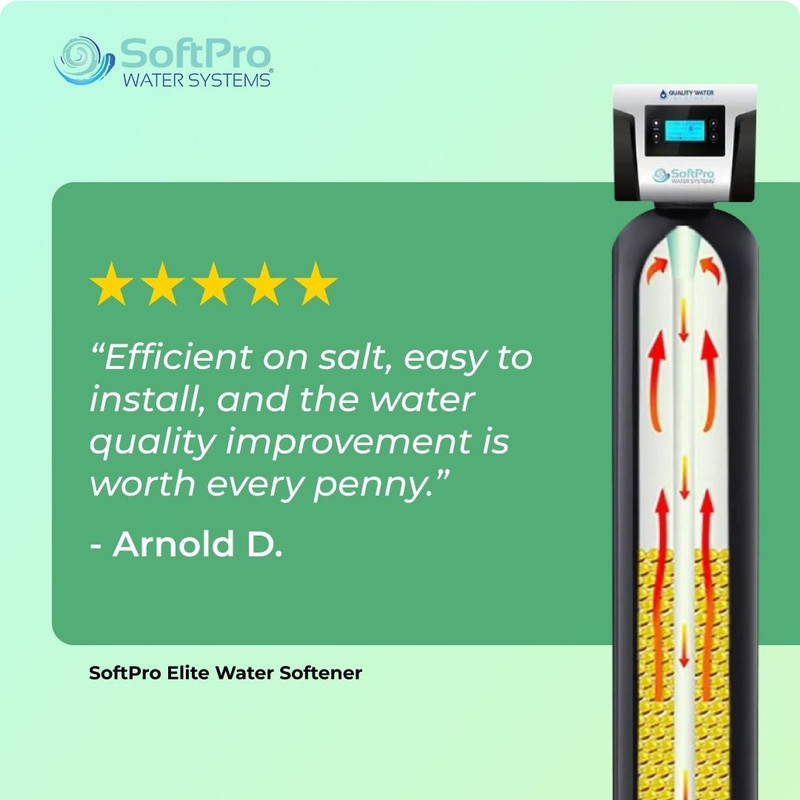
City-water takeaway
If your home has regulated municipal water and the main enemy is chlorine plus hardness, resin quality should be the first filter you use when narrowing options. That is where SoftPro Elite gains separation immediately.
#2. Top-rated water softener for municipal water — upflow regeneration cuts salt and water waste dramatically
SoftPro Elite is the top-rated water softener for municipal water when efficiency matters because its upflow regeneration uses far less salt and water than standard downflow designs. On city water, waste shows up twice: in salt purchases and on the monthly utility bill. SoftPro Elite is designed to reduce salt use by up to 75% and water use by up to 64% versus downflow regeneration. That is not a cosmetic improvement. It changes long-term ownership cost.
In homes with metered municipal service, regeneration efficiency is easy to appreciate. Every unnecessary gallon used in backwash or brining is a billable gallon. The SoftPro Elite typically regenerates using roughly 2 to 4 pounds of salt and about 18 to 30 gallons of water per cycle, where many conventional downflow systems are substantially heavier users. That matters in cities where water and sewer charges rise together.
Why upflow matters on treated municipal supply
Downflow systems regenerate from the top down, which is older but less efficient. Upflow regeneration sends brine in the opposite direction so the resin bed is restored more evenly, with less channeling and lower waste. In practical terms, the benefits for city-water homeowners are clear:
Lower salt per regeneration cycle Lower rinse-water consumption Less frequent brine tank refilling Better use of total resin capacity Lower 5- to 10-year operating costFor Elena Navarro, who tracks household spending carefully, this was one of the easiest benefits to understand. Their prior salt-free conditioner did not actually remove hardness. Once they switched to a true ion exchange system, operating efficiency became the next major concern, and SoftPro Elite’s upflow design addressed it well.
Prose comparison: SoftPro Elite vs Whirlpool WHES40E and Fleck 5600SXT
This is where the gap widens between a premium city-water softener and the common big-box alternatives. Whirlpool’s WHES40E is popular because it is accessible and familiar, but timer-like behavior and less sophisticated reserve handling can lead to extra cycles or reduced usable capacity depending on household patterns. Fleck 5600SXT systems are durable in many homes, but most are still configured around conventional downflow regeneration. When you compare actual operating behavior, SoftPro Elite’s upflow approach is more efficient and more modern. It needs less salt, wastes less water, and avoids the “one-size-fits-all” regeneration style that keeps many older systems stuck in the past.
The cost difference does not stop at supplies. City homes pay for incoming water and often for sewer based on usage, so every extra regeneration cycle has a second financial effect. Over several years, that adds up. Buyers who only look at purchase price miss the full ownership story. Once you factor in salt use, water use, and resin longevity, SoftPro Elite becomes the smarter value and, in my judgment, worth every penny.
Why city utility bills make efficiency non-negotiable
On well systems, some inefficiency is hidden because homeowners are not billed for each regeneration gallon in the same way. On city supply, the meter sees everything. That is why I weigh regeneration efficiency more heavily for municipal applications than many generic review sites do. SoftPro Elite was clearly built with that reality in mind.
If you want a Best Water Softener System for municipal service, do not separate performance from operating cost. In city homes, they are the same conversation.
#3. Best Water Softener For City Water sizing starts with your Consumer Confidence Report, not guesswork
The most accurate way to size a city-water softener is to combine household usage with the hardness data already published in your municipal Consumer Confidence Report. Every U.S. Public water utility is required by the EPA to publish an annual Consumer Confidence Report, or CCR. In many cases, that report includes hardness in milligrams per liter as calcium carbonate. To convert mg/L to grains per gallon, divide by 17.1. That simple conversion gives homeowners a far better starting point than guessing from soap behavior or online ZIP-code databases.
QWT’s sizing process is one of the reasons SoftPro Elite stands out. According to the company, Jeremy Phillips regularly uses CCR data and household details to match buyers with the right grain capacity. That is a practical support advantage, especially for city-water customers who already have a reliable municipal data source.
How to size a water softener for city water: 5 steps
Sizing a municipal water softener is straightforward when you use actual city hardness data and realistic daily water use. Here is the process I recommend:
Find your city hardness in the CCR or from the utility website. Convert mg/L to GPG by dividing by 17.1 if needed. Estimate household use at 75 gallons per person per day. Multiply people × 75 × GPG to get grains needed per day. Multiply that daily number by 7 to target roughly weekly regeneration.For the Navarro family:
4 people × 75 gallons × 16 GPG = 4,800 grains per day. 4,800 × 7 = 33,600 grains per week.That points cleanly to a 48K unit, which gives comfortable usable capacity without overspending or forcing too-frequent regeneration.
Matching hardness by region to SoftPro Elite capacity
USGS data and municipal reporting both show that city-water hardness varies sharply by metro. Here are a few realistic ranges homeowners should know:
- Phoenix often lands around 18 to 24 GPG San Antonio often falls around 15 to 20 GPG Indianapolis commonly runs about 12 to 18 GPG Minneapolis is often in the 13 to 17 GPG range Columbus is usually milder, often around 10 to 14 GPG
Those ranges matter because sizing should reflect both hardness and family size. In general:
- 32K works for smaller households with moderate city hardness 48K is a strong fit for 3 to 4 people in the low-to-mid hard range 64K suits larger families or harder city water 80K and 110K are appropriate for high-demand homes or very hard municipal supplies
Why oversizing and undersizing both create problems
Undersizing causes frequent regeneration, higher wear, and the occasional surprise of hard water breakthrough on heavy-use days. Oversizing can be less efficient and may cost more upfront than the household will ever justify. SoftPro Elite improves the picture with 15% reserve capacity rather than the 30% or more often required by standard systems, so it uses capacity more intelligently.
Mateo Navarro originally assumed “bigger is safer.” In practice, correct sizing was the smarter move. The 48K size matched their Dallas-area hardness and four-person demand without paying for excess tank they did not need.
City-water takeaway
For municipal homes, the CCR is one of the most underused free tools in water treatment. Use it first, then size from math, not marketing.
#4. Demand-initiated metered regeneration — the best softener chloramine resistance is wasted if the control logic is inefficient
SoftPro Elite is a better city-water softener because it regenerates based on actual gallons used instead of wasting salt on fixed schedules. Many entry-level softeners regenerate by timer logic or rigid programming patterns that do not reflect real family behavior. That is a problem on city water, where occupancy changes, travel happens, and utility costs are visible every month. SoftPro Elite uses demand-initiated metered regeneration, a 15% reserve capacity, and an emergency 15-minute quick cycle if remaining capacity drops below 3%.
Those details sound small until you live with them. They mean the system uses resin capacity more completely, regenerates only when necessary, and still protects against running out of soft water. That is the kind of feature set I look for in higher-end municipal softeners.
Why metering beats timer-based softeners in city homes
A family’s water use is rarely identical week to week. School breaks, work travel, overnight guests, and seasonal laundry spikes all change demand. Metered softeners track actual gallon usage and respond accordingly. Timer-based systems often regenerate whether the capacity is spent or not. The result is unnecessary salt consumption and unnecessary water discharge.
SoftPro Elite adds two city-friendly details:
- a 7-day auto-refresh vacation mode that protects the system during low-use periods a self-charging capacitor that retains settings for 48 hours during power outages
Those are practical ownership features, not brochure filler.
Prose comparison: SoftPro Elite vs Whirlpool WHES40E and Culligan service models
Timer-oriented big-box systems such as the Whirlpool WHES40E can be appealing at first because they are easy to find and often cheaper upfront. But cheaper hardware becomes less impressive once a homeowner sees the effect of unnecessary cycles over years of municipal water billing. The SoftPro Elite meters demand precisely and uses a lower reserve strategy, so more of the system’s actual capacity is available to the household before regeneration begins.
Culligan takes a different route, leaning on a service-network model that often softpro elite keeps customers tied to technician visits for adjustments or troubleshooting. In many markets, service calls can run from around $80 to $150. SoftPro Elite’s smart controller, 4-line LCD touchpad, and self-diagnostic features reduce that friction. QWT’s support structure, including the operational systems associated with Heather Phillips, is a notable plus for buyers who want direct guidance without dealer dependency. For city-water homeowners who value control, efficiency, and lower lifetime hassle, SoftPro Elite is worth every penny.
How the Navarro family benefited from smarter reserve logic
The Navarros take short trips several times a year to visit relatives in Oklahoma. With their old setup, water-treatment performance felt inconsistent after absences. A system with vacation mode and smarter metering is better suited to real family patterns. It is one of those things buyers underestimate until they have lived through both approaches.
City-water takeaway
On municipal water, control logic is part of efficiency. A high-quality resin bed paired with wasteful scheduling is still a compromised system. SoftPro Elite avoids that mistake.
#5. Top-rated water softener for municipal water installation — city homes usually need a simpler setup than buyers expect
Installing a water softener on city water is usually simpler than on private supply because municipal treatment already handles most sediment and the pressure is reliably stable. That matters because many homeowners overcomplicate the project. In most city-water homes, SoftPro Elite does not require a sediment pre-filter, does not need a pressure tank, and operates comfortably within normal municipal pressure ranges. It requires a minimum of 25 PSI, while city systems typically deliver around 40 to 80 PSI. Its maximum working pressure is 125 PSI, though I still recommend a pressure regulator if a home consistently exceeds 80 PSI.
That combination makes SoftPro Elite an unusually DIY-friendly premium system. Its quick-connect fittings, pre-installed bypass valve, and straightforward drain requirements fit what most suburban utility rooms already provide.
What a typical city-water installation needs
Most municipal installations boil down to a few basics:
- access to the main water line after the meter a nearby drain, utility sink, or approved standpipe a GFCI outlet for the control head enough footprint for mineral and brine tanks local code compliance for any backflow requirement
Because city water is already treated, you are generally not designing around heavy sediment, sulfur, or unstable pump output. That is another reason I consider the SoftPro Elite a strong fit for suburban homes, townhomes, and newer builds on municipal lines.
Why flow rate matters in larger city homes
The SoftPro Elite is rated for 15 GPM https://www.softprowatersystems.com/products/softpro-elite-water-softener continuous flow and 18 GPM peak. Those numbers matter when a home has multiple bathrooms, a dishwasher running, and laundry going at the same time. In practical terms, that is enough throughput for many 3- to 5-bathroom homes without the pressure-starved feel some undersized softeners create.
Mateo Navarro paid close attention to this because their household often overlaps showers, laundry, and kitchen use in the evening. The SoftPro Elite fit their routine without becoming a bottleneck, which is exactly what a properly sized municipal softener should do.
SoftPro Elite vs dealer-dependent installation models
One reason some homeowners end up overpaying is that certain brands make the process feel more proprietary than it needs to be. Kinetico-style dealer models are often praised for design features, but they also tend to lock owners into local networks and proprietary parts. SoftPro Elite uses standard industry components, supports DIY-friendly installation, and still offers direct guidance from QWT if needed. That gives buyers more flexibility and usually lowers lifetime cost. For many city-water homeowners, that open-support model is worth every penny.
City-water takeaway
Most municipal installs are simpler than people think. If a home has decent access, normal city pressure, a drain, and power, SoftPro Elite is one of the easier premium systems to place and live with.
#6. Certifications, warranty, and long-term value — why SoftPro Elite finishes first as the Best Water Softener System
SoftPro Elite earns the top overall spot because it combines independent certifications, a lifetime valve and tank warranty, and city-water-specific performance in one package. Plenty of softeners have one standout feature. Fewer have the full set: NSF 372 certification for lead-free compliance, IAPMO materials safety certification, 15 GPM continuous flow, 18 GPM peak, chlorine-resistant resin, upflow efficiency, smart controls, and lifetime coverage on the valve and tanks. That is what separates a good purchase from a system that still looks smart ten years later.
Craig Phillips, who founded SoftPro Water Systems through Quality Water Treatment, built the brand around a fairly straightforward idea: offer higher-spec water treatment without the inflated dealer structure that defines much of the market. From an independent reviewer’s standpoint, that background matters because the product line reflects it.
Why independent certifications should influence your shortlist
NSF and IAPMO markings are not window dressing. They tell buyers the system materials and lead-free claims are tied to recognized third-party standards rather than self-described marketing language. For municipal water customers, that matters because the softener is being installed directly into a treated household supply that the family uses every day for bathing, cleaning, and appliance protection.
When I narrow finalists, certification is one of the quickest quality filters I use. SoftPro Elite passes that filter comfortably.
Long-term ownership math favors higher efficiency
A city-water softener should be judged on more than purchase price. Over 10 years, homeowners pay for:
- initial equipment installation or plumbing help salt regeneration water possible service calls possible resin replacement replacement of lower-end systems sooner
This is where SoftPro Elite consistently scores well. Its resin is expected to last 15 to 20 years in chlorinated city water, its control platform is designed to avoid unnecessary cycles, and the warranty coverage is unusually strong for the class. Big-box systems often look less expensive only because their future costs are hidden.
The Navarro family outcome
For the Navarros, the biggest visible improvements were immediate: less spotting on fixtures, better soap performance, and no more white crust collecting around faucets. The less visible win is the one I value more: a https://softprowatersystems.com/pages/best-water-softener-for-city-water properly sized municipal softener with efficient regeneration, durable resin, and enough flow to support a busy four-person household for the long term.
City-water takeaway
If you strip away branding and look only at the facts that matter on municipal supply, SoftPro Elite is the most complete city-water softener I have evaluated in its category.
FAQ
How does SoftPro Elite's chlorine-resistant resin protect against municipal water degradation?
SoftPro Elite protects against municipal-water degradation by using 8% crosslink ion exchange resin that is built to tolerate ongoing disinfectant exposure better than basic residential resin. The system is rated for up to 2 PPM continuous chlorine, which is important because city utilities routinely maintain disinfectant residuals to protect public health. Over time, chlorine and chloramines can oxidize resin beads, reducing exchange capacity and shortening service life.
In practical terms, that means a softer water system can start passing hardness even when the brine tank still has salt. Resin damage may also show up as bead breakdown, fouling, or inconsistent performance. SoftPro Elite’s resin profile is one of the biggest reasons it fits city homes so well. Based on the specs and real-world outcomes I have reviewed, a 15 to 20 year resin life in chlorinated municipal use is a strong advantage. For a household like the Navarros in Frisco, where the water is hard and continuously disinfected, that durability is not theoretical. It is central to long-term value.
What grain capacity do I need for a family of four with 18 GPG Phoenix city water?
A family of four with 18 GPG Phoenix city water typically needs a 48K or 64K softener, depending on actual daily water use and whether there are usage spikes. The sizing formula is simple: people × 75 gallons per day × hardness in GPG. For four people at 18 GPG, that equals 5,400 grains per day. Multiply by 7 days and you get 37,800 grains per week.
That puts a 48K SoftPro Elite in the correct range for many homes, while a 64K may make sense if the family has high consumption, multiple bathrooms, frequent guests, or wants a bit more cushion between regenerations. Phoenix is one of the harder municipal-water markets in the country, often running around 18 to 24 GPG, so sizing matters. Based on the specs and performance data, I would start with the 48K for average use and move to 64K when the household’s real demand is above normal.
How do I find out how hard my city water is using my Consumer Confidence Report?
The fastest free method is to pull your municipal Consumer Confidence Report from your water utility’s website and look for hardness, often listed in mg/L as calcium carbonate. Every public water utility in the U.S. Must publish a CCR under EPA rules. If hardness is shown in mg/L, divide the number by 17.1 to convert it to grains per gallon.
For example, if your report shows 274 mg/L hardness, that equals about 16 GPG. That is almost exactly the kind of number seen in harder parts of the Dallas area. If the report does not list hardness clearly, many utilities will provide it by phone or in supplemental online testing data. A CCR is usually accurate enough to begin softener sizing, especially on stable municipal systems. That is one reason QWT’s city-water sizing process stands out. According to the company, Jeremy Phillips regularly uses CCR data to guide buyers toward the proper SoftPro Elite capacity.
Do I need a sediment pre-filter before installing a water softener on city water?
In most city-water installations, no sediment pre-filter is required before a water softener. Municipal treatment systems are already filtering and treating the supply before it reaches the home, so the heavy sediment loads common in private water sources are usually not present. That is one of the practical differences between municipal and non-municipal installations.
There are exceptions. If your city has old mains, recent line work, or unusual particulate complaints, a pre-filter can still be useful. But it is not a default requirement for most municipal homes. For the average suburban installation, SoftPro Elite can go in directly on the incoming city line, provided there is normal plumbing access, a drain, and power for the controller. Based on the specifications and standard city-water conditions, this simpler setup is one more reason SoftPro Elite makes sense for homeowners who want premium performance without unnecessary add-ons.
Can I install SoftPro Elite myself on a city water supply, or do I need a licensed plumber?
Many homeowners can install SoftPro Elite themselves on city water if they are comfortable cutting into plumbing, making secure drain connections, and following local code. Municipal installations are usually more straightforward because water pressure is stable, the incoming line is predictable, and there is typically no need for extra pre-treatment. SoftPro Elite also includes DIY-friendly details such as quick-connect fittings and a pre-installed bypass valve.
That said, local plumbing codes vary, especially around shutoff placement, drain air gaps, and backflow considerations. Some homeowners also prefer to have a plumber handle startup to keep things simple. In the Navarros’ case, Mateo could have managed the mechanical work, but they chose professional installation to move faster. Based on the product design and city-water conditions, SoftPro Elite is one of the more approachable premium systems for DIY-minded homeowners, but a licensed plumber is still the safest route if you want guaranteed code compliance.
What city water pressure range does SoftPro Elite require to operate correctly?
SoftPro Elite requires at least 25 PSI to operate correctly and can handle up to 125 PSI. That fits comfortably within normal municipal water service, which is commonly around 40 to 80 PSI in residential neighborhoods. Because city pressure is usually much more stable than private supply, municipal homes are a very good match for this type of softener.
The only caution point is high-pressure urban or hillside zones where pressure can creep above 80 PSI. In those cases, I recommend a pressure-reducing valve to protect not just the softener, but the entire plumbing system. Flow performance is also strong, with 15 GPM continuous and 18 GPM peak. That makes the system appropriate for many multi-bathroom homes where simultaneous use is common. Based on the specs, pressure compatibility is not a hurdle for most city-water buyers considering SoftPro Elite.
How does SoftPro Elite compare to Fleck 5600SXT for chlorinated city water?
SoftPro Elite is the stronger city-water choice because it combines chlorine-resistant 8% crosslink resin, upflow regeneration, lower reserve requirements, and a more complete ownership package. Fleck 5600SXT systems remain respected for simplicity and broad parts availability, but many are configured in conventional downflow format and do not deliver the same efficiency profile on municipal water. That matters when the homeowner is paying for both water and sewer on every regeneration cycle.
SoftPro Elite also adds a 15-minute emergency quick cycle when remaining capacity drops below 3%, a 7-day vacation refresh, 48-hour settings retention via self-charging capacitor, NSF 372 certification, and lifetime warranty coverage on valve and tanks. Fleck-based setups vary widely by assembler and dealer, so quality can be less standardized from one seller to another. Based on the specifications and the city-water use case specifically, SoftPro Elite is the better-engineered and better-supported option for chlorinated municipal homes.
Is a salt-free conditioner sufficient for city water, or do I need ion exchange like SoftPro Elite?
A salt-free conditioner can reduce some scale adhesion, but it does not remove hardness minerals from the water. If your goal is true soft water, you need ion exchange. That is the key distinction many city-water shoppers miss. Salt-free TAC or catalytic systems may help with surface scaling in some homes, but the water remains technically hard. You can still see soap performance issues, dry skin, mineral film, and reduced appliance efficiency.
SoftPro Elite uses ion exchange, which removes hardness minerals at a very high level and changes how the water behaves throughout the home. That is why families who have already tried conditioners often notice a major difference when they switch. The Navarros are a good example. Their first attempt reduced some visible spotting, but the water still fought every cleaning product they used. Based on the chemistry and the real-world results, SoftPro Elite is the right choice if the homeowner wants actual soft water rather than partial scale control.
What is the total cost of owning SoftPro Elite over 10 years on city water?
Total 10-year cost depends on installation, local salt prices, and how expensive your water and sewer rates are, but SoftPro Elite generally compares very favorably once operating costs are included. The reason is simple: lower salt use, lower regeneration water use, long resin life, and reduced service dependency. A cheaper timer-based softener can look attractive on day one, then become more expensive over time through extra salt, extra water, and shorter component life.
City-water buyers should think in layers:
- purchase price install cost annual salt consumption annual regeneration water cost service visits probable resin longevity
Because SoftPro Elite uses upflow regeneration and demand metering, it usually lowers the recurring part of that equation. Add the lifetime valve and tank warranty and the economics get stronger. Based on the specs and long-term ownership pattern, I consider it one of the best total-value purchases in the city-water category.
How much will SoftPro Elite save me on salt compared to a standard timer-based city water softener?
SoftPro Elite can reduce salt consumption by up to 75% compared with older downflow systems, especially when those systems regenerate on timer logic rather than true demand. Actual savings vary by hardness, family size, and water use, but the engineering advantage is real. Upflow regeneration uses the resin bed more efficiently, and demand-initiated control prevents unnecessary cycles.
For a city-water homeowner, those savings are meaningful because they show up in two places: fewer salt bags purchased and fewer gallons charged by the municipality during regeneration. In a four-person home like the Navarros’, the yearly difference can be substantial over time even if monthly savings look modest at first. Based on the numbers and the city billing structure, efficiency is one of the strongest reasons I rank SoftPro Elite above conventional alternatives.
Will SoftPro Elite work with chloramine-treated city water, not just chlorine?
Yes. SoftPro Elite is well suited to chloramine-treated city water as well as free-chlorine systems. Chloramines are used by many municipalities because they maintain a longer-lasting disinfectant residual across distribution systems. They are effective for treatment, but they also create ongoing oxidative stress for many softener resins. That is why resin selection matters so much for city-water equipment.
SoftPro Elite’s 8% crosslink resin and city-oriented design make it a solid fit for chloramine environments, especially compared with lower-spec systems that do not account for disinfectant exposure over the long term. Homeowners who know their city uses chloramines should still review the CCR and, if desired, consider additional carbon treatment for taste or odor preferences. But for hardness removal itself, based on the specifications and municipal-use profile, SoftPro Elite is an excellent match.
Is a 110K grain SoftPro Elite necessary for a large family on 24 GPG Phoenix city water?
Sometimes, yes. A 110K model is appropriate when both hardness and demand are extreme. For example, a six-person family using Phoenix municipal water at 24 GPG would calculate this way: 6 × 75 × 24 = 10,800 grains per day. Multiply by 7 and the weekly requirement becomes 75,600 grains. That is squarely in the territory where an 80K may work for some households, but a 110K becomes the more comfortable and practical choice if the family has high real-world use.
This is why broad online recommendations are not enough. Family size, fixture count, bathing habits, laundry volume, and guest traffic all matter. SoftPro Elite offers 32K, 48K, 64K, 80K, and 110K options, which is one of its strengths. Based on the math, a very large household on 24 GPG municipal water is exactly the kind of scenario where the 110K version makes sense.
Bottom Line
After evaluating city-water softeners on the factors that actually determine long-term homeowner satisfaction—chlorine resistance, regeneration efficiency, metered control, flow performance, certifications, warranty, and ease of installation—the SoftPro Elite is the clear winner. It is the best water softener for city water because it solves the two biggest municipal challenges at the same time: hard water scale and disinfectant-related resin wear. For homeowners in hard-water metros like Dallas, Phoenix, Indianapolis, or San Antonio, the SoftPro Elite is not just a strong option. Based on the evidence, it is the one I would recommend first.